Showing posts with label What happened in 1979?. Show all posts

July 21, 2008

Samir Kuntar, a typical arab stain on humanity

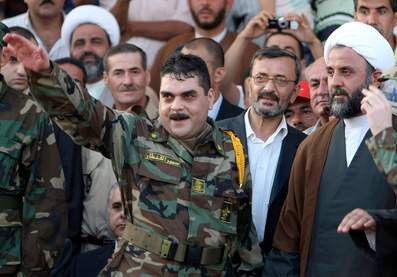
Samir Kuntar on arrival in Lebanon, complete with Hizbullah uniform and Heil Hitler nazi scumbag salute (AFP).
A small word of advice for Samir Kuntar. Ask your comrades in the PLO and Hizbullah what was the ultimate fate of various killers of Israelis and Jews years after they thought their actions were forgotten.

For example, what happened to the killers of Israel's athletes at the 1972 Munich Olympics and their masterminds?

The last of them died in unnatural circumstances 24 years after that horrific massacre.

So learn from the past and draw your conclusions, Samir Kuntar. It would be in your best interests to learn to sleep with one eye open, you filthy nazi Arab rat, for even though you may learn how to do sleep, it will not save you as everyone knows you will not live long enough to tell the story to your grandchildren of how you bashed in the brains of a 4 year old Jewish child with your rifle butt in front of the child's father. Via JPost:
Samir Kuntar, a Lebanese Druse, was sentenced to four life sentences in 1979 for the deaths of Danny Haran, 28, his two daughters and a policeman in Nahariya.

A member of the Palestine Liberation Front, Kuntar and four others sailed 10 kilometers under the cover of night from south Lebanon to Nahariya in a 55-horse-power rubber boat. The mission, led by Kuntar and titled the Nasser Operation, brought the terrorists to the Nahariya coast around midnight on April 22, 1979.

The group murdered police officer Eliahu Shahar after he stumbled upon the gang. The men then entered an apartment building at Rehov Jabotinski 61 and broke into the Haran family's apartment, taking them hostage.

Kuntar's gang took Danny and four-year-old Einat Haran hostage as police reinforcements arrived on the scene.

Haran's wife, Smadar, hid with her two-year-old daughter Yael in a crawl space above the couple's bedroom. Smadar tried to muffle the girl's cries, and accidentally smothered her.

As officers arrived at the building, the terrorists pulled Danny and Einat out of the apartment building and down to the beach, where a shootout with police and soldiers ensued.

Kuntar shot Danny Haran at close-range and threw his body into the sea to make sure he died. He then bashed 4 year old Einat's head on rocks and with butt of his rifle, killing her instantly.

Two terrorists were killed by police during the shootout, while Kuntar and Ahmed al-Abrass were captured.

Abrass was released in May 1985 during the Ahmed Jibril prisoner exchange, while Kuntar remained in prison.

In a 2003 article in The Washington Post, Smadar Haran recalled her final moments with Danny.

"I will never forget the joy and the hatred in [the terrorists'] voices as they swaggered about hunting for us, firing their guns and throwing grenades," Haran wrote. "As I lay there, I remembered my mother telling me how she had hidden from the Nazis during the Holocaust. 'This is just like what happened to my mother,' I thought."

Kuntar has openly expressed pride about the killings over the years.

He hails from the Lebanese mountain village of Aabey and has been in Israeli prison longer than any other Lebanese.

Many say Hizbullah kidnapped IDF reservists Eldad Regev and Ehud Goldwasser in 2006 to use them as bargaining tools to force Kuntar's release.

Kuntar got married while in prison and he receives conjugal visits from his wife.

His release has been brought up before in negotiations with Hizbullah head Hassan Nasrallah. In 2006, he was offered as part of a failed deal to free Goldwasser and Regev.

Two years earlier, Hizbullah demanded Kuntar's release a part of the Elhannan Tannenbaum prisoner deal that sent 435 Palestinian and Lebanese prisoners back home.

May 28, 2008

The Golan Heights and the Syrian-Israeli Negotiations

By Dore Gold

1) Israeli negotiators will quickly discover three core areas in their discussions with the Syrians that they will not resolve easily: delineation of an agreed boundary, security arrangements, and the Syrian-Iranian alliance.
2) Just prior to the outbreak of the 1973 Yom Kippur War, Syria deployed 1,400 tanks along the border against a total Israeli force of 177 tanks (a force ratio of 8 to 1 in favor of Syria). Should Syria's considerable missile forces be used to delay Israel's reserve mobilization, then the importance of the Golan terrain will increase as Israel's small standing army will have to fight for longer without reserve reinforcement.

3) When Israel reached its Treaty of Peace with Egypt in 1979, it agreed to fully withdraw from the Sinai Peninsula to the international border. Syria illegally occupied Israeli territories during the 1950s that were within Israel's international borders: the southern demilitarized zone at al-Hamma, the Banias area, and the strip of coastal territory along the northeast shoreline of the Sea of Galilee.

4) If Israel were to agree to the June 4, 1967, line, as Syria demands, it would be rewarding Syrian aggression. Moreover, it could compromise Israel's control of its largest fresh water reservoir. Israel should not have to be arguing with the Syrians over the question of whether a future Israeli-Syrian boundary should correspond to the June 4, 1967, line or to the older international border, for neither of these lines is defensible.

5) The U.S. has given Israel repeated diplomatic assurances in the past that Israel will not have to come down from the Golan Heights, beginning with a September 1, 1975, letter from President Gerald Ford to Prime Minister Yitzhak Rabin. It was renewed prior to the 1991 Madrid Peace Conference by Secretary of State James Baker. During the Clinton administration, Secretary of State Warren Christopher renewed the Ford commitment in a letter dated September 19, 1996.

6) Even if, by prior agreement with Tehran, the Syrians took steps that appeared to be downgrading relations, Israel's concession of the Golan Heights would be irreversible, while the political orientation of states in the Middle East is notoriously changeable. It would be a cardinal error for Israel to put into jeopardy its own security by agreeing to come down from the Golan Heights.

Go to http://tinyurl.com/6qxgmz to read the full article.

June 09, 2007

Forty Years Later, Doing Nothing Is the Best Policy

From Forty Years Later, Doing Nothing Is the Best Policy:

In this week's torrent of 40th anniversary recollections about the Six-Day War, one TV image cut straight to the chase: King Faisal of Saudi Arabia staring into a camera to say, "The essential point remains the total elimination of Israel." The king's statement of principles was captured in "Six Days in June," an impressive two-hour documentary that aired Monday on PBS. For all the noise about peace in the 40 years since, the Saudi monarch's silver bullet solution is still the basic Arab mindset.

As do-gooders and militants reflect on what Israel should have done, what Arabs failed to do, what the UN ought to do, I vote for doing nothing. Regardless of the peace treaties with Israel forged by President Sadat of Egypt and King Hussein of Jordan, the overwhelming majority of Arabs need more time to dismantle their war posture. At this point, Israel's primary antagonists in this conflict, the Palestinian Arabs, are no longer an entity that can be engaged. Having dissolved into a myriad of warring gangs, there is no one to settle with.

And still more time is necessary to contemplate whether what has been achieved can be retained. Egypt's 1979 peace accord will not survive a day if the Muslim Brotherhood succeeds in its decades-old effort to topple President Mubarak's dynastic military reign. The Brotherhood is significantly closer to that goal now. In Jordan, since the peace treaty of 1994, the anti-Semitic discourse has grown thick, leaving little room to imagine that peace with Israel could survive a change in leadership.

It is pointless even to think about structuring new accords with Arab societies that are relentlessly marching toward various stages of radicalism, Islamic or otherwise. It would not help, and it would not hold. As for Israel, going forward with more unilateral evacuations, as in Lebanon and Gaza, has only liberated land for terrorist operations.

We Are Back

SmoothStone is excited to announce that we have moved to our new site at: https://smoothstoneblog.net   Look forward to seeing you th...