Don Bordenkircher, who served two years as national director of prison and jail operations in Iraq, said that about 40 prisoners he spoke with "boasted of being involved in the transport of WMD warheads to Syria" in the three months prior to Operation Iraqi Freedom. He said he was told the WMDs were shipped by truck into Syria, and some ended up in Lebanon's Bekaa Valley. Prisoners who said they worked at the al-Muthana Chemical Industries site said the cargo included nitrogen mustard gas warheads for Tariq I and II missiles.
Showing posts with label Lebanon. Show all posts
Showing posts with label Lebanon. Show all posts
July 31, 2008
U.S. Official: Iraqis Told Me WMDs Sent to Syria
The truth continues to eke out. From U.S. Official: Iraqis Told Me WMDs Sent to Syria:


July 21, 2008
Samir Kuntar, a typical arab stain on humanity
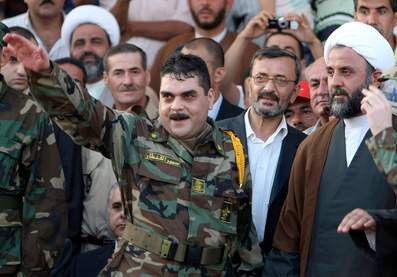
A small word of advice for Samir Kuntar. Ask your comrades in the PLO and Hizbullah what was the ultimate fate of various killers of Israelis and Jews years after they thought their actions were forgotten.
For example, what happened to the killers of Israel's athletes at the 1972 Munich Olympics and their masterminds?
The last of them died in unnatural circumstances 24 years after that horrific massacre.
So learn from the past and draw your conclusions, Samir Kuntar. It would be in your best interests to learn to sleep with one eye open, you filthy nazi Arab rat, for even though you may learn how to do sleep, it will not save you as everyone knows you will not live long enough to tell the story to your grandchildren of how you bashed in the brains of a 4 year old Jewish child with your rifle butt in front of the child's father. Via JPost:
For example, what happened to the killers of Israel's athletes at the 1972 Munich Olympics and their masterminds?
The last of them died in unnatural circumstances 24 years after that horrific massacre.
So learn from the past and draw your conclusions, Samir Kuntar. It would be in your best interests to learn to sleep with one eye open, you filthy nazi Arab rat, for even though you may learn how to do sleep, it will not save you as everyone knows you will not live long enough to tell the story to your grandchildren of how you bashed in the brains of a 4 year old Jewish child with your rifle butt in front of the child's father. Via JPost:
Samir Kuntar, a Lebanese Druse, was sentenced to four life sentences in 1979 for the deaths of Danny Haran, 28, his two daughters and a policeman in Nahariya.
A member of the Palestine Liberation Front, Kuntar and four others sailed 10 kilometers under the cover of night from south Lebanon to Nahariya in a 55-horse-power rubber boat. The mission, led by Kuntar and titled the Nasser Operation, brought the terrorists to the Nahariya coast around midnight on April 22, 1979.
The group murdered police officer Eliahu Shahar after he stumbled upon the gang. The men then entered an apartment building at Rehov Jabotinski 61 and broke into the Haran family's apartment, taking them hostage.
Kuntar's gang took Danny and four-year-old Einat Haran hostage as police reinforcements arrived on the scene.
Haran's wife, Smadar, hid with her two-year-old daughter Yael in a crawl space above the couple's bedroom. Smadar tried to muffle the girl's cries, and accidentally smothered her.
As officers arrived at the building, the terrorists pulled Danny and Einat out of the apartment building and down to the beach, where a shootout with police and soldiers ensued.
Kuntar shot Danny Haran at close-range and threw his body into the sea to make sure he died. He then bashed 4 year old Einat's head on rocks and with butt of his rifle, killing her instantly.
Two terrorists were killed by police during the shootout, while Kuntar and Ahmed al-Abrass were captured.
Abrass was released in May 1985 during the Ahmed Jibril prisoner exchange, while Kuntar remained in prison.
In a 2003 article in The Washington Post, Smadar Haran recalled her final moments with Danny.
"I will never forget the joy and the hatred in [the terrorists'] voices as they swaggered about hunting for us, firing their guns and throwing grenades," Haran wrote. "As I lay there, I remembered my mother telling me how she had hidden from the Nazis during the Holocaust. 'This is just like what happened to my mother,' I thought."
Kuntar has openly expressed pride about the killings over the years.
He hails from the Lebanese mountain village of Aabey and has been in Israeli prison longer than any other Lebanese.
Many say Hizbullah kidnapped IDF reservists Eldad Regev and Ehud Goldwasser in 2006 to use them as bargaining tools to force Kuntar's release.
Kuntar got married while in prison and he receives conjugal visits from his wife.
His release has been brought up before in negotiations with Hizbullah head Hassan Nasrallah. In 2006, he was offered as part of a failed deal to free Goldwasser and Regev.
Two years earlier, Hizbullah demanded Kuntar's release a part of the Elhannan Tannenbaum prisoner deal that sent 435 Palestinian and Lebanese prisoners back home.
July 14, 2008
Hizbullah Report: Airman Ron Arad Died Trying to Escape During 1988 Israeli Raid
More heartache for the Arad family, may HaShem comfort them. The pathetic global observers of the drama, tragedy and catastrophe in the middle east only weep for thieving Arabs, yet the most grievous of victims are Israelis, for whom noone in the global community cries. May HaShem comfort the Arad family and may HaShem avenge the murder of Ron Arad and impart punishment upon all those who weep for Arad's murderers. From Hizbullah Report: Airman Ron Arad Died Trying to Escape During 1988 Israeli Raid:
After 22 years, two photographs of missing Israel Air Force airman Ron Arad, as well as three letters written by him and fragments of a diary, were given to his wife Tami on Sunday. The personal material was part of an 80-page report by Hizbullah detailing the group's search for Arad, who was shot down over Lebanon and captured alive in 1986. The report, which did not solve the mystery of what happened to Arad, represents the first stage of a planned prisoner swap with Hizbullah. The Hizbullah report is merely an updated version of a report it passed to Israel in 2004, defense officials said on Sunday. The conclusion remains the same as the 2004 report, that Arad had tried to escape when his guards went to fight during Israel's Maydun operation on May 4, 1988, and probably died.
French Military Against Assad's Presence at Bastille Day Parade
Do the French really feel this way? From French Military Against Assad's Presence at Bastille Day Parade:
The French government has banned a demonstration by French veterans meant in part to protest against the presence of Syrian President Bashar al-Assad as an honored guest at the July 14 Bastille Day military parade, French media reported on Friday. French veterans blame Syria for the deaths of 58 French members of a UN peacekeeping force in Lebanon in 1983. The FNAME veterans group has called on soldiers marching in Monday's parade to wear black armbands to protest Assad's presence. Former French President Jacques Chirac has previously said he would not be at the July 14 ceremonies because of Assad's participation. Chirac blames Assad for the murder of former Lebanese prime minister Rafik Hariri, for which Syrian intelligence services have been implicated.
July 06, 2008
The Iranian Roots of Hizbullah
The Iranian Roots of Hizbullah(1)
By: Dr. Nimrod Raphaeli*
Iran/Lebanon #448 June 17, 2008
Table of Contents:
<#1>Introduction
<#2>Akhteri's Background and Proselytizing Activity
<#3>Facing the First Crisis
<#4>The Splintering of Amal and the Creation of Hizbullah
<#5>Syria Allowed the Passage of Military Aid to Hizbullah
<#6>The Establishment of Al-Manar TV
<#7>Hizbullah's Social Institutions ñ Identical To Iran's
<#8>Refusal to Pay for Electricity
<#9>The Shi'ization of Syria
<#10>Conclusion
<#11>Notes
"Iran is the only country that does not interfere in Lebanon." - Mahmoud Ahamdinejad(2)
Introduction
Ahmadinejad's absurd statement coincided ironically with the publication in the London daily Al-Sharq Al-Awsat of an extensive interview with Mohammad Hassan Akhteri, who has recently completed a total of 14 years as Iran's ambassador to Syria. By his own admission, Akhteri was the most senior Iranian liaison official with Hizbullah, Hamas, and Islamic Jihad, and the architect of the special relationship between Iran and Syria. Akhteri was also the founder in Damascus of the Palestinian-Iranian Friendship Society.
In the interview, published in two parts on May 14 and May 15, 2008, Akhteri distinguishes between the spiritual father (al-ab al-rouhi) of Hizbullah, the one who initiated the idea, and the "field father" (al-ab al-midani). Akhteri considers himself the latter, while his predecessor in Damascus, Ali Muhtashemi, was the former.(3)
Akhteri's Background and Proselytizing Activity
Akhteri was born in Qom in 1928, and came to diplomacy from his position as Friday preacher at the Samnan mosque, north of Tehran. He studied religious jurisprudence at a hawza (a Shi'ite religious center) in Qom. Concurrently with his role as ambassador to Damascus, Akhteri has served for the last four years as the head of the International Society of aal-al-beit, the Prophet Mohammad's descendents, who are viewed by the Shi'ite branch of Islam as the legitimate rulers of Islam. The Aal-al-beit Society is also engaged in spreading "Shi'ite Islamic consciousness," essentially a proselytizing organization which seeks converts to Shi'ite Islam.
Akhteri served two terms as ambassador to Damascus: the first, longer term from 1986 to 1997, and the second from 2005 to January 2008. But before serving as ambassador, he had accumulated a record as a proselytizer: He spent some time in Homs, Syria in 1969, and from there he went to Lebanon for two and a half years, through 1972, to carry out religious activities and tabligh (spreading of Islam).
Facing the First Crisis
Akhteri arrived in Syria in 1986, at a time of conflict between the Palestinians and the Shi'ite Movement ñ Amal ñ that was created by Imam Moussa al-Sadr in the 1960s as a social-service organization intended to improve the living conditions of the Shi'ite community in southern Lebanon, one of the poorest communities in the country. Al-Sadr, born in Iran and educated in Qom, also established the Shi'ite Supreme Islamic Council in 1969. Al-Sadr flew to Tripoli, Libya on August 25, 1978 and there he disappeared. His disappearance, six months prior to the success of the Iranian revolution, was a key factor in the marginalization of the Amal Movement, and the birth of Hizbullah.
The Splintering of Amal and the Creation of Hizbullah
The Islamic regime of Iran after the revolution regarded the Amal Movement with suspicion because it seemed insufficiently religious, and lacking the suitability or will to be an instrument of spreading the Iranian revolution. In addition, it was led by politicians, many of them were secular, rather than by clerics. In fact, the very name Amal (Hope) lacked religious ring. On its part, Amal was disenchanted with Iran because during its conflict with the Palestinians Iran supported the latter.
As a result, Iran encouraged elements from the Amal Movement to splinter and establish a religious party that would be more in tune with the concept of wilayat al-faqih, [the Rule of the Jurisprudent] introduced by Ayatollah Ruhollah Khomeini, the spiritual and political leader of the Islamic Republic. Once that party, Hizbullah, was established, Khomeini ordered elements of the Revolutionary Guards to go to Lebanon to train its young cadres.
The Iranian ambassador to Damascus from 1982-85, Ali Akbar Mohtashemi, was quoted by Al-Sharq Al-Awsat as telling an Iranian newspaper that Hizbullah gained part of its battle experience through its participation in the war against Iraq. According to Mohtashemi, more than 100,000 young Lebanese received military training both in Lebanon and in Iran in groups of 300 fighters. Akhteri has also conceded that elements of Hizbullah fought in the war with Iraq "either within our ranks or by themselves."
Akhteri recalls that five planeloads of Revolutionary Guards and Basij (youth militia) landed in Damascus to stand with Hizbullah during the 1982 Israeli invasion of southern Lebanon, but Khomeini stopped any further dispatch of Iranian forces to Lebanon because of logistical problems. According to Akhteri, supplying a military contingency in Lebanon would have been difficult with the war raging between Iran and Iraq. The only other alternative would have been to go through Turkey, but Turkey was a member of NATO. Hence, the real alternative was to train Hizbullah's cadres in Lebanon itself.
Syria Allowed the Passage of Military Aid to Hizbullah
The arming of Hizbullah could not have been possible without the support of Syria. When Hizbullah was established, Syria was in control of Lebanon, and no one could come and go without the approval of the Syrian regime. In fact, Akhteri admits that throughout his "diplomatic" mission to Syria he coordinated his activities in Lebanon with Ghazi Kandan, who was chief of Syrian intelligence in Lebanon from 1982-2001, and who became minister of interior in October 2003 and who in 2005 allegedly committed suicide. (Kandan may have been involved in the assassination of former Lebanese prime minister Rafiq Al-Hariri. As the international investigation of the assassination was beginning to implicate the Syrian regime, Kandan may have been silenced by a staged ñ unexplainable ñ suicide.)
In his interview with Al-Asharq Al-Awsat , Ambassador Akhteri stated with evident pride that Hizbullah, Islamic Jihad, and Hamas are the "legitimate children of the Iranian revolution," and that Iran has supported them financially, politically, and morally. There was coordination between Iran and each of these organizations, but Akhteri argues that any final decisions were taken by these groups themselves.
The Establishment of Al-Manar TV
To solidify its control over its supporters and to spread Shi'ite Islamic fervor, Hizbullah needed its own television station, but Lebanon was reluctant to approve an independent station for Hizbullah. According to former Syrian vice president Abdul Halim Khaddam, now living in exile in France, the Iranian president at the
time, Hashemi Rafsanjani, called Syrian President Hafez Al-Assad to obtain a license for Al-Manar TV. Assad told then-Lebanese prime minister Rafiq Al-Hariri to grant the permit, and the permit was granted. The establishment of Al-Manar was one of the steps that, Akhteri stresses, "strengthened the independence of Hizbullah on the Lebanese political scene."(4)
Hizbullah's Social Institutions ñ Identical To Iran's
In addition to Al-Manar TV, Hizbullah was able, with Iran's financing, to establish a wide range of social, financial, and economic institutions that strengthened the loyalty of the Shi'ites in Lebanon to Iran. One of the significant financial arms of Hizbullah is the Shahid Foundation (Martyrs Foundation), an Iran-based organization established in 1982 in Iran to assist victims of the Iran-Iraq war. In 2007, the U.S. Treasury targeted "Iran-based Martyrs Foundation," including its U.S. branch, and the finance firm Al-Qardh al-Hassan (Good Deed Loan) as front organizations for Hizbullah. According to the Treasury, the Martyrs Foundation branches in Lebanon provided financial support to the families of killed or imprisoned Hizbullah and Islamic Jihad members, including suicide bombers in the Palestinian territories. Al-Qardh al-Hassan created the Goodwill Charitable Organization (munatzamat al-niyya al-hasana al-khairiya) in Dearborn, Michigan as a fundraising office for the Martyrs Foundation.
According to the U.S. Treasury, Hizbullah used the Al-Qardh al-Hassan's financial arms as cover to manage its financial activity. Al-Qardh al-Hassan is run by Hussein al-Shami, a senior Hizbullah leader who has also served as a member of Hizbullah's Shura Council and as head of several Hizbullah-controlled organizations.(5)
Hussein Raslan, in charge of the social functions in the Martyrs Foundation, told Islamonline on August 13, 2006, that the idea for the Foundation originated with Khomeini, who provided the financing from zakat (alms contributed by Muslims). Raslan said that the first Hizbullah school was established in Beirut in 1988, but that eventually the school was incorporated into the Imam al-Mahdi Foundation in 2002. The flow of funds [from Iran], Raslan said, nabled Hizbullah to establish a series of enterprises including those dealing with food supply, gasoline and printing houses. Hizbullah schools in Lebanon, either under Khomeini or al-Mahdi Foundations, follow the Iranian curriculum.
Hizbullah has also established a network of hospitals (dispensing Iranian-made medicines), banks, and cultural organizations. Finally, there are the Hizbullah police, who are responsible for maintaining "good manners" on the street ñ meaning, among other things, that women are always veiled in public. Money from Iran keeps this massive apparatus running.
Refusal to Pay for Electricity
One of the least-known facts about the dominance of Hizbullah in parts of Lebanon is the refusal of its members to pay their electric bill. Without the means to force them to do so, the Lebanese government is left with one of its largest budgetary problems ñ the growing subsidy the government has to pay to the national power company, Electricite du Liban.
The Shi'ization of Syria
The International Aal-Al-Beit Society, which operates under Iran's supreme leader, currently Ali Khamenei, and whose primary function is to spread Shi'ism (tashayu') in the rest of the Muslim world, took advantage of Iran's special relations with Syria in order to establish Shi'ite religious seminaries in Damascus. In fact, Damascus has now at least three hawzas (religious centers,) and is considered the third largest Shi'ite center in the world after Najaf and Qom. While Akhteri minimizes the proselytizing functions of the Aal Al-Beit society in Syria, there are concerns sounded in both Syria and the Arab world about the tashayu' effort ñ not only in Syria but in other countries, such as Egypt and Sudan.
Conclusion
This paper highlights two significant facts: first, Hizbullah was created and sustained by Iran. Iranian financial support has made it possible for this political organization to build a network of schools, hospitals, social welfare organizations and above all, military prowess. It now serves as an extension of Iran's strategic
expansion into the Mediterranean.
Second, it is absolutely evident that Iran's extended arm into Lebanon would not have been possible without the collusion or approval of the Syrian regime. Syria is also the main conduit of arms from Iran to Hizbullah.
*Dr. Nimrod Raphaeli is the Editor of The MEMRI Economic Blog,
http://www.memrieconomicblog.org.
Notes
(1) This dispatch is based on a presentation made by the author at a
panel on "The Iranization of Lebanon?" at the Potomac Institute on
May 23, 2008.
(2) Press conference in Tehran, May 13, 2008.
(3) Al-Sharq Al-Awsat (London), May 14 and May 15, 2008.
(4) Manal Lutfi, "The Limits of the State of Hizbullah," Al-Sharq
Al-Awsat (London), May 20, 2009
(5) http://www.ustreas.gov/press/releases/200772410294613432.htm,
July 24, 2007.
MEMRI
P.O. Box 27837, Washington, DC 20038-7837
Phone: (202) 955-9070
Fax: (202) 955-9077
www.memri.org
By: Dr. Nimrod Raphaeli*
Iran/Lebanon #448 June 17, 2008
Table of Contents:
<#1>Introduction
<#2>Akhteri's Background and Proselytizing Activity
<#3>Facing the First Crisis
<#4>The Splintering of Amal and the Creation of Hizbullah
<#5>Syria Allowed the Passage of Military Aid to Hizbullah
<#6>The Establishment of Al-Manar TV
<#7>Hizbullah's Social Institutions ñ Identical To Iran's
<#8>Refusal to Pay for Electricity
<#9>The Shi'ization of Syria
<#10>Conclusion
<#11>Notes
Introduction
Ahmadinejad's absurd statement coincided ironically with the publication in the London daily Al-Sharq Al-Awsat of an extensive interview with Mohammad Hassan Akhteri, who has recently completed a total of 14 years as Iran's ambassador to Syria. By his own admission, Akhteri was the most senior Iranian liaison official with Hizbullah, Hamas, and Islamic Jihad, and the architect of the special relationship between Iran and Syria. Akhteri was also the founder in Damascus of the Palestinian-Iranian Friendship Society.
In the interview, published in two parts on May 14 and May 15, 2008, Akhteri distinguishes between the spiritual father (al-ab al-rouhi) of Hizbullah, the one who initiated the idea, and the "field father" (al-ab al-midani). Akhteri considers himself the latter, while his predecessor in Damascus, Ali Muhtashemi, was the former.(3)
Akhteri's Background and Proselytizing Activity
Akhteri was born in Qom in 1928, and came to diplomacy from his position as Friday preacher at the Samnan mosque, north of Tehran. He studied religious jurisprudence at a hawza (a Shi'ite religious center) in Qom. Concurrently with his role as ambassador to Damascus, Akhteri has served for the last four years as the head of the International Society of aal-al-beit, the Prophet Mohammad's descendents, who are viewed by the Shi'ite branch of Islam as the legitimate rulers of Islam. The Aal-al-beit Society is also engaged in spreading "Shi'ite Islamic consciousness," essentially a proselytizing organization which seeks converts to Shi'ite Islam.
Akhteri served two terms as ambassador to Damascus: the first, longer term from 1986 to 1997, and the second from 2005 to January 2008. But before serving as ambassador, he had accumulated a record as a proselytizer: He spent some time in Homs, Syria in 1969, and from there he went to Lebanon for two and a half years, through 1972, to carry out religious activities and tabligh (spreading of Islam).
Facing the First Crisis
Akhteri arrived in Syria in 1986, at a time of conflict between the Palestinians and the Shi'ite Movement ñ Amal ñ that was created by Imam Moussa al-Sadr in the 1960s as a social-service organization intended to improve the living conditions of the Shi'ite community in southern Lebanon, one of the poorest communities in the country. Al-Sadr, born in Iran and educated in Qom, also established the Shi'ite Supreme Islamic Council in 1969. Al-Sadr flew to Tripoli, Libya on August 25, 1978 and there he disappeared. His disappearance, six months prior to the success of the Iranian revolution, was a key factor in the marginalization of the Amal Movement, and the birth of Hizbullah.
The Splintering of Amal and the Creation of Hizbullah
The Islamic regime of Iran after the revolution regarded the Amal Movement with suspicion because it seemed insufficiently religious, and lacking the suitability or will to be an instrument of spreading the Iranian revolution. In addition, it was led by politicians, many of them were secular, rather than by clerics. In fact, the very name Amal (Hope) lacked religious ring. On its part, Amal was disenchanted with Iran because during its conflict with the Palestinians Iran supported the latter.
As a result, Iran encouraged elements from the Amal Movement to splinter and establish a religious party that would be more in tune with the concept of wilayat al-faqih, [the Rule of the Jurisprudent] introduced by Ayatollah Ruhollah Khomeini, the spiritual and political leader of the Islamic Republic. Once that party, Hizbullah, was established, Khomeini ordered elements of the Revolutionary Guards to go to Lebanon to train its young cadres.
The Iranian ambassador to Damascus from 1982-85, Ali Akbar Mohtashemi, was quoted by Al-Sharq Al-Awsat as telling an Iranian newspaper that Hizbullah gained part of its battle experience through its participation in the war against Iraq. According to Mohtashemi, more than 100,000 young Lebanese received military training both in Lebanon and in Iran in groups of 300 fighters. Akhteri has also conceded that elements of Hizbullah fought in the war with Iraq "either within our ranks or by themselves."
Akhteri recalls that five planeloads of Revolutionary Guards and Basij (youth militia) landed in Damascus to stand with Hizbullah during the 1982 Israeli invasion of southern Lebanon, but Khomeini stopped any further dispatch of Iranian forces to Lebanon because of logistical problems. According to Akhteri, supplying a military contingency in Lebanon would have been difficult with the war raging between Iran and Iraq. The only other alternative would have been to go through Turkey, but Turkey was a member of NATO. Hence, the real alternative was to train Hizbullah's cadres in Lebanon itself.
Syria Allowed the Passage of Military Aid to Hizbullah
The arming of Hizbullah could not have been possible without the support of Syria. When Hizbullah was established, Syria was in control of Lebanon, and no one could come and go without the approval of the Syrian regime. In fact, Akhteri admits that throughout his "diplomatic" mission to Syria he coordinated his activities in Lebanon with Ghazi Kandan, who was chief of Syrian intelligence in Lebanon from 1982-2001, and who became minister of interior in October 2003 and who in 2005 allegedly committed suicide. (Kandan may have been involved in the assassination of former Lebanese prime minister Rafiq Al-Hariri. As the international investigation of the assassination was beginning to implicate the Syrian regime, Kandan may have been silenced by a staged ñ unexplainable ñ suicide.)
In his interview with Al-Asharq Al-Awsat , Ambassador Akhteri stated with evident pride that Hizbullah, Islamic Jihad, and Hamas are the "legitimate children of the Iranian revolution," and that Iran has supported them financially, politically, and morally. There was coordination between Iran and each of these organizations, but Akhteri argues that any final decisions were taken by these groups themselves.
The Establishment of Al-Manar TV
To solidify its control over its supporters and to spread Shi'ite Islamic fervor, Hizbullah needed its own television station, but Lebanon was reluctant to approve an independent station for Hizbullah. According to former Syrian vice president Abdul Halim Khaddam, now living in exile in France, the Iranian president at the
time, Hashemi Rafsanjani, called Syrian President Hafez Al-Assad to obtain a license for Al-Manar TV. Assad told then-Lebanese prime minister Rafiq Al-Hariri to grant the permit, and the permit was granted. The establishment of Al-Manar was one of the steps that, Akhteri stresses, "strengthened the independence of Hizbullah on the Lebanese political scene."(4)
Hizbullah's Social Institutions ñ Identical To Iran's
In addition to Al-Manar TV, Hizbullah was able, with Iran's financing, to establish a wide range of social, financial, and economic institutions that strengthened the loyalty of the Shi'ites in Lebanon to Iran. One of the significant financial arms of Hizbullah is the Shahid Foundation (Martyrs Foundation), an Iran-based organization established in 1982 in Iran to assist victims of the Iran-Iraq war. In 2007, the U.S. Treasury targeted "Iran-based Martyrs Foundation," including its U.S. branch, and the finance firm Al-Qardh al-Hassan (Good Deed Loan) as front organizations for Hizbullah. According to the Treasury, the Martyrs Foundation branches in Lebanon provided financial support to the families of killed or imprisoned Hizbullah and Islamic Jihad members, including suicide bombers in the Palestinian territories. Al-Qardh al-Hassan created the Goodwill Charitable Organization (munatzamat al-niyya al-hasana al-khairiya) in Dearborn, Michigan as a fundraising office for the Martyrs Foundation.
According to the U.S. Treasury, Hizbullah used the Al-Qardh al-Hassan's financial arms as cover to manage its financial activity. Al-Qardh al-Hassan is run by Hussein al-Shami, a senior Hizbullah leader who has also served as a member of Hizbullah's Shura Council and as head of several Hizbullah-controlled organizations.(5)
Hussein Raslan, in charge of the social functions in the Martyrs Foundation, told Islamonline on August 13, 2006, that the idea for the Foundation originated with Khomeini, who provided the financing from zakat (alms contributed by Muslims). Raslan said that the first Hizbullah school was established in Beirut in 1988, but that eventually the school was incorporated into the Imam al-Mahdi Foundation in 2002. The flow of funds [from Iran], Raslan said, nabled Hizbullah to establish a series of enterprises including those dealing with food supply, gasoline and printing houses. Hizbullah schools in Lebanon, either under Khomeini or al-Mahdi Foundations, follow the Iranian curriculum.
Hizbullah has also established a network of hospitals (dispensing Iranian-made medicines), banks, and cultural organizations. Finally, there are the Hizbullah police, who are responsible for maintaining "good manners" on the street ñ meaning, among other things, that women are always veiled in public. Money from Iran keeps this massive apparatus running.
Refusal to Pay for Electricity
One of the least-known facts about the dominance of Hizbullah in parts of Lebanon is the refusal of its members to pay their electric bill. Without the means to force them to do so, the Lebanese government is left with one of its largest budgetary problems ñ the growing subsidy the government has to pay to the national power company, Electricite du Liban.
The Shi'ization of Syria
The International Aal-Al-Beit Society, which operates under Iran's supreme leader, currently Ali Khamenei, and whose primary function is to spread Shi'ism (tashayu') in the rest of the Muslim world, took advantage of Iran's special relations with Syria in order to establish Shi'ite religious seminaries in Damascus. In fact, Damascus has now at least three hawzas (religious centers,) and is considered the third largest Shi'ite center in the world after Najaf and Qom. While Akhteri minimizes the proselytizing functions of the Aal Al-Beit society in Syria, there are concerns sounded in both Syria and the Arab world about the tashayu' effort ñ not only in Syria but in other countries, such as Egypt and Sudan.
Conclusion
This paper highlights two significant facts: first, Hizbullah was created and sustained by Iran. Iranian financial support has made it possible for this political organization to build a network of schools, hospitals, social welfare organizations and above all, military prowess. It now serves as an extension of Iran's strategic
expansion into the Mediterranean.
Second, it is absolutely evident that Iran's extended arm into Lebanon would not have been possible without the collusion or approval of the Syrian regime. Syria is also the main conduit of arms from Iran to Hizbullah.
*Dr. Nimrod Raphaeli is the Editor of The MEMRI Economic Blog,
Notes
(1) This dispatch is based on a presentation made by the author at a
panel on "The Iranization of Lebanon?" at the Potomac Institute on
May 23, 2008.
(2) Press conference in Tehran, May 13, 2008.
(3) Al-Sharq Al-Awsat (London), May 14 and May 15, 2008.
(4) Manal Lutfi, "The Limits of the State of Hizbullah," Al-Sharq
Al-Awsat (London), May 20, 2009
(5) http://www.ustreas.gov/press/releases/200772410294613432.htm,
July 24, 2007.
MEMRI
P.O. Box 27837, Washington, DC 20038-7837
Phone: (202) 955-9070
Fax: (202) 955-9077
June 01, 2008
Who is Samir Kuntar?
He's a Muslim killer of Jewish children - and he will soon be walking the streets, breathing, eating, and lusting after his next Jewicide victim. Via Palestinian Media Watch:
Samir Kuntar is the Lebanese terrorist serving four life sentences in an Israeli jail for murdering a four-year-old Israeli girl, Eynat Haran. He crushed her head with his rifle butt after murdering her father, Dani, and two policemen. Eynat's two-year-old sister, Yael, also died in the terror attack. Hezbollah leader Hassan Nasrallah announced last week that Israel had agreed to release Kuntar in exchange for Ehud Goldwasser and Eldad Regev (or their remains), the IDF reservists kidnapped in July 2006. Media reports indicate that such a deal is imminent.The Kuntar letter:
After the killing of international terrorist Imad Mughniyeh in Syria three months ago, Kuntar wrote a letter to Nasrallah in which he glorified terrorists and martyrdom, and vowed to continue in the path of terror "until complete victory." The following is the text of the Kuntar letter:My dear and honored commander and leader, The Secretary General Hassan Nasrallah,
Peace be unto you and our Shahids, and may Allah's mercy and blessing be upon you.Peace be unto the men in the convoys of the righteous.
Peace be unto he who has [given and has] not taken anything other than the Shahadah (Martyrdom), the highest rank of honor before Allah.
Peace be unto the distinguished, glamorous convoys [of Shahids] who travel toward eternity, toward the men of glory, dignity and pride, toward those who have marked our path for hundreds of years.
Peace be unto the last to leave, the Hajj and leader, Imad Mughniyeh.
Peace be unto him, as he passes the message on to those who await his arrival, as he brings them stories of the glory and victories, news of steadfastness and loyalty of the men of the fulfilled promise [a reference to the operation in which the two Israeli soldiers were kidnapped which was called the 'Fulfilling the Promise',] news of "those who still wait [for Shahadah]; but they have never changed (their determination for Shahada)." [Quote from Quran, Sura 33:23.]
Peace be unto him, as he announces to the most honored among the Believers [previous Shahids] that the waiting convoys have chosen [they await the Shahadah] to draw their swords, and their swords are calling out: "We are far from degradation" [a Nasrallah's phrase].
May peace be unto you, Hajj Imad. My oath and pledge is that my place will be at the battlefront, which is soaked in the sweat of your giving, and the blood of the most beloved among men [Shahids], and that I shall continue down the path, until complete victory.
I give to you, Sir Abu Hadi [name for Hassan Nasrallah] and to all the Jihad Figthers, my congratulations and [my] renewed loyalty.
[Al-Hayat Al-Jadida, February 19, 2008]
May 21, 2008
Israel Faults Restrictions on UNIFIL
From Israel Faults Restrictions on UNIFIL:
Israel is expected to air complaints on UNIFIL's performance in Lebanon with French Foreign Minister Bernard Kouchner in Jerusalem this week, diplomatic officials said Tuesday. France has 2,000 troops in the UNIFIL mission. Despite the UNIFIL peacekeepers in southern Lebanon, thousands of rockets have been smuggled south of the Litani River, according to the officials. Hizbullah is no longer operating in the open areas, but rather inside the villages, and UNIFIL cannot go into the villages without first getting the approval of the Lebanese army, something that drastically reduces its effectiveness.
The anti-Hizbullah Shi'ite mufti of Tyre, Ali al-Amin, told the Italian daily Corriere della Sera on Saturday:"Peace mission? You must be kidding. I will tell you what UNIFIL troops in southern Lebanon are. They are tourists, simple, faint-hearted and ignorant tourists ... UNIFIL forces pretend not to see anything."
May 12, 2008
Exclusive: Hizballah received 35 new Iranian speedboats shortly before current crisis
DEBKAfile's military sources report that three weeks before Hezballah seized western Beirut, the Shiite terrorist group took delivery of 35 fast speedboats for use with explosives from Iran. The craft can threaten US Sixth Fleet and Israel Navy shipping close to Lebanese shores, reach Israel's Haifa and Ashdod Mediterranean ports and raid its coastal oil installations.
The speedboats were tailor-made for Hizballah by Iranian Revolutionary Guards shipyards at Bandar Abbas as the only marine terror fleet operating in Mediterranean waters. Our military sources report the boats are capable of carrying chemical, biological and radiological weapons systems.
They were delivered in mid-April by an Iranian freighter at the Syrian port of Latakia and trucked to Naimah port south of Beirut. There they were hidden in the subterranean hangars belonging to Ahmed Jibril, head of the Palestinian Liberation Front-General Command. Today, the PLF-GC is financed and directed by the Revolutionary Guards. The hangars were constructed in the seventies by East Germany engineers with a protected Mediterranean anchorage and made virtually impenetrable by sea or air.
The speedboats were tailor-made for Hizballah by Iranian Revolutionary Guards shipyards at Bandar Abbas as the only marine terror fleet operating in Mediterranean waters. Our military sources report the boats are capable of carrying chemical, biological and radiological weapons systems.
They were delivered in mid-April by an Iranian freighter at the Syrian port of Latakia and trucked to Naimah port south of Beirut. There they were hidden in the subterranean hangars belonging to Ahmed Jibril, head of the Palestinian Liberation Front-General Command. Today, the PLF-GC is financed and directed by the Revolutionary Guards. The hangars were constructed in the seventies by East Germany engineers with a protected Mediterranean anchorage and made virtually impenetrable by sea or air.
April 16, 2008
Israel Says Syria Arming Hizbullah Despite UN Resolution 1701
Lebanon and its puppet government Syria must adhere to the full implementation of all provisions of Resolution 1701 which ended the 34-day war between Israel and Hezbollah in August 2006.
The U.N. Security Resolution calls for the disarming of Hezbollah and all other militias in Lebanon and greater progress toward a permanent ceasefire and long-term solution to the conflict between Lebanon and Israel.
Syria is supplying Lebanon's Hizbullah militia with rockets in violation of UN Security Council Resolution 1701, Israeli Defense Minister Ehud Barak charged on Tuesday. The resolution called for the disarming of all militias - an allusion to Hizbullah as well as to Palestinian militant groups - and the prevention of illegal arms sales and smuggling operations in Lebanon.
The U.N. Security Resolution calls for the disarming of Hezbollah and all other militias in Lebanon and greater progress toward a permanent ceasefire and long-term solution to the conflict between Lebanon and Israel.
Syria is supplying Lebanon's Hizbullah militia with rockets in violation of UN Security Council Resolution 1701, Israeli Defense Minister Ehud Barak charged on Tuesday. The resolution called for the disarming of all militias - an allusion to Hizbullah as well as to Palestinian militant groups - and the prevention of illegal arms sales and smuggling operations in Lebanon.
January 25, 2008
Beirut Bomb Kills Ten
From Beirut Bomb Kills Ten:
A senior intelligence officer investigating killings largely blamed on Syria was slain with three other people in a car bombing in the Lebanese capital, Beirut, on Friday, officials said.
Captain Wissam Eid, 31, a member of the Internal Security Forces (ISF), was among the dead along with his bodyguard, a security official told AFP. He said 36 other people were wounded, with nine taken to hospital. Two of the wounded were in critical condition."Eid was a key member of the ISF and was involved in many investigations concerning bombings in Lebanon, including a February 2007 bombing in a Christian area," the official said. "He was involved in sensitive probes and this is a major loss for us."
Many of the bombings over the past three years have been blamed by Lebanon's Western-backed parliamentary majority on neighbouring Syria, a charge denied by Damascus.
January 21, 2008
Germany warns Jewish community of terror threat from Lebanon
From Ha'aretz:
German security authorities have issued a warning to the Jewish community of an increased threat of terrorist attack emanating from Lebanon, a senior Jewish official said Sunday. Stefan Kramer, general secretary of the Central Council of German Jews, told Deutsche Presse-Agentur (DPA) the warning had been received more than a week ago, on January 11. He confirmed weekend news reports that increased precautions were being taken. The increased threat was to synagogues and Jewish schools across the country, and not just in Berlin, as was reported earlier, Kramer said. Kramer referred to information from Lebanon and a possible link to the current trial in Dusseldorf of a Lebanese man, Youssefal-Hajj Dib, 23, on charges of attempting to blow up German trains with suitcase bombs in July 2006.
January 09, 2008
Israel Protests Katyusha Fire from Lebanon
From Israel Protests Katyusha Fire from Lebanon:
Israel Tuesday submitted a strong protest to the UN Secretary General and to the President of the Security Council regarding the shooting of two Katyusha rockets from Lebanon at Shlomi, in the western Galilee.
The rocket fire constitutes a serious violation of UN Security Council Resolution 1701 and serves as further proof that the resolution is not being strictly implemented. Israel has for months been warning of the military consolidation and strengthening of the armed militias in southern Lebanon, including Hizbullah, north and south of the Litani River, as well as the continuing smuggling of Syrian and Iranian arms from Syria into Lebanon.
UNIFIL must take very decisive action to implement the resolution and take effective measures to prevent the smuggling of Syrian and Iranian arms across the Syrian-Lebanese border, to prevent the entry of extremist elements into Lebanon, and to disarm all the armed militias and organizations in Lebanon, according to UN Security Council resolutions.
Bomb Wounds Two UN Peacekeepers in Lebanon
How odd. No outrage from the hypocritical international community. From Bomb Wounds Two UN Peacekeepers in Lebanon:
Two Irish UN peacekeeping soldiers were slightly wounded when their vehicle hit a roadside bomb in south Lebanon on Tuesday near Rmaileh, 35 km south of Beirut and not far from Ain al-Hilweh, a hotbed for Islamist militant groups. It was the third attack on UNIFIL since the Israel-Hizbullah War ended in August 2006.
December 14, 2007
The Next War with Hizbullah
The IDF could have crippled the Hezbollah bastards, if they weren't so worried about world opinion. From Strategic Assessment/Institute for National Security Studies-Tel Aviv University, The Next War with Hizbullah:
Hizbullah's main operational goal prior to the July 2006 war was to conduct a war of attrition against the Israeli home front. Hizbullah invested most of its efforts in assembling an extensive missile system, including rockets with ranges of over 100 km, under the assumption that Israel would not conduct significant ground operations south of the Litani River. Most of the organization's operational mass was concentrated in this area.
From the very beginning of the fighting, Hizbullah maintained a continuous bombardment of Israeli territory in order to wear down the Israeli home front. As Hizbullah had predicted, the IDF countered with massive airpower. Only a few ground-based operations were conducted, and primarily close to the border. At the same time, a number of weak points in Hizbullah's operational preparations surfaced. The first was the IDF's success in damaging its medium and long-range rocket systems.
The destruction of Hizbullah's Zelzal rockets in Beirut in the first hours of fighting appears to have been especially painful.
November 24, 2007
Lebanon Enters a New Crisis
And it serves them right. Why? For allowing Hezbullah to hide amongst their civilian population, for hiding members of the detestable PFLP terrorist group in the Bekaa Valley responsible for airline hijackings, and carrying out suicide bomb attacks against U.S. targets in Lebanon and kidnapping and sometimes killing U.S. citizens there, and for being one of the Arab nations that attacked Israel in 1948. From Lebanon Enters a New Crisis:
Lebanon's worst crisis since the 1975-90 civil war builds to a climax at midnight Friday, when the term of President Emile Lahoud ends. Despite weeks of French-led mediation, Lebanon's factions appeared unlikely to reach a consensus on Lahoud's replacement by the deadline, plunging the country into a constitutional limbo. Unlike Lebanon's civil war, often characterized as a Christian-Muslim conflict, this crisis has mobilized the country's Sunni and Shiite Muslim communities against each other, with Christians divided between the two camps.
November 21, 2007
With Annapolis Approaching, Jewish Refugees Speak Up
I haven't been able to bring myself to write about how Annapolis is going to be a disaster for Jews, for the Jewish Holy city of Jerusalem, and for the entire legitimate and sovereign nation of Israel, who will be cut, carved up, and savagely drawn and quartered by all the nations in the world. I can only bring myself to quote and paraphrase what has happened - and what will happen; it is just too painful to witness. From With Annapolis Approaching, Jewish Refugees Speak Up:
Please read the entire article here.Jews originally from Arab countries demand a say at Annapolis, particularly in light of UN archives papers proving Arab plots against Jews in 1947.
Two organizations representing Jews originally from Arab countries demand to be heard at Annapolis - particularly in light of documents from the UN archives revealing official Arab collusion and laws against Jews back in 1947. Violence, arrests and confiscation of property were part of official policy towards Jews in several Arab countries, the papers show.
In addition, it is estimated that the 850,000 Jews who fled Arab countries after Israel's founding in 1948 left behind assets currently worth more than $300 billion.
Heskel M. Haddad, president of the World Organization of Jews from Arab Countries, said last week that when the Palestinian Authority negotiators at Annapolis raise the issue of Arab refugees, the Israelis must remind them of the hundreds of thousands of Jews who left their homes and property in Arab countries.
In addition, Stanley Urman, executive director of Justice for Jews from Arab Countries (JJAC), says that justice cannot be served unless the forced exodus of Jewish refugees, and the conditions under which they left, are included on the agenda at the upcoming conference.The information on the Arab League's official persecution of Jews has been long-known, even if not well-publicized. On May 16, 1948, the New York Times reported, "Already in some Moslem states such as Syria and Lebanon there is a tendency to regard all Jews as Zionist agents and 'fifth columnists.' There have been violent incidents with feeling running high. There are indications that the stage is being set for a tragedy of incalculable proportions. In Syria a policy of economic discrimination is in effect against Jews. 'Virtually all' Jewish civil servants in the employ of the Syrian Government have been discharged. Freedom of movement has been 'practically abolished.' Special frontier posts have been established to control movements of Jews. In Iraq no Jew is permitted to leave the country unless he deposits £5,000 ($20,000) with the Government to guarantee his return. No foreign Jew is allowed to enter Iraq even in transit. In Lebanon Jews have been forced to contribute financially to the fight against the United Nations partition resolution on Palestine. Acts of violence against Jews are openly admitted by the press, which accuses Jews of 'poisoning wells,' etc. Conditions... are worst in Yemen and Afghanistan, whence many Jews have fled in terror to India. Conditions in most of the countries have deteriorated in recent months, this being particularly true of Lebanon, Iran and Egypt."
November 19, 2007
U.S. Judge Orders Iran to Pay $2.65 Billion to 1983 Beirut Attack Families
From U.S. Judge Orders Iran to Pay $2.65 Billion to 1983 Beirut Attack Families:
Iran must pay $2.65 billion to the families of the 241 U.S. service members killed in the 1983 bombing of the U.S. Marine barracks in Beirut, a federal judge declared Friday. U.S. District Judge Royce C. Lamberth described his ruling as the largest-ever such judgment by an American court against another country. Iran has been blamed for supporting the militant group Hizbullah, which carried out the suicide bombing in Beirut. It was the worst terrorist act against U.S. targets until the Sep. 11, 2001 attacks.
November 12, 2007
Jumblatt Calls for End of Lebanon-Israel Conflict
From Jumblatt Calls for End of Lebanon-Israel Conflict via Daily Alert:
The time has come to take Lebanon out of the Israeli-Arab conflict, Druse leader Walid Jumblatt said in an interview with the Arab satellite television station Al Arabiya on Thursday. According to Israel Radio, Jumblatt said that Lebanon should rest after being in a state of war with Israel for thirty years.
November 11, 2007
Jewish Leaders Welcome Interpol Most-Wanted Notice in Argentine Bombing
Via VOA:
Interpol has put five Iranians and a Lebanese man on its mostwanted list for the 1994 bombing of a Jewish community center in Buenos Aires. In Miami, VOA's Brian Wagner reports Jewish community leaders says the effort will pressure the Islamicgovernment to stop supporting terrorist activities. Delegates at Interpol's general assembly in Morocco approved theso-called "red notices" against the five Iranians and one Lebanese suspected in the attack. Argentine prosecutors are seeking Interpol's support in their probe into the bombing of a Jewish center in Buenos Aires, which killed 85 people and wounded more than 200 others. Argentine officials allege Iran ordered the attack and had Hezbollah militants carry it out.Iran's response rejecting this decision is here.
November 01, 2007
Israel: Hizbullah Has Tripled Its Land-to-Sea Missile Arsenal
From Israel: Hizbullah Has Tripled Its Land-to-Sea Missile Arsenal:
Hizbullah has tripled its arsenal of C-802 land-to-sea missiles and has rehabilitated its strength north of the Litani River, according to information handed over by Israel to the UN and published in a UN report. During the war, a C-802 missile struck the INS Hanit off the Lebanese coast, killing four naval servicemen. The report states that Hizbullah's long-range missile teams are deployed north of the Litani River, and that "most of the new missiles include [the Iranian-made] Zelzal and Fajr missiles that have a range of over 250 kilometers and are capable of hitting areas south of Tel Aviv." Hizbullah also has established an anti-aircraft unit armed with surface-to-air missiles.
Subscribe to:
Posts (Atom)
-
"Hinei ma tov uma na'im shevet achim gam yachad." "Behold, how good and how pleasant it is to be united like brothers and...
-
Below are some photos, originally printed on celluloid, of the Temple Mount and the mosques on top of it just before the birth of modern Zio...

